
Andrea carried out her research in the SMODD team at the Softmat laboratory.
On 20th of October, she defended her thesis entitled: “Development of microporous organogels: from the immobilization of probiotics for oral delivery to the capture of their therapeutically relevant metabolites”
Gut microbiota is a complex ecosystem of microorganisms that plays an essential role in maintaining human health, notably by contributing to the maturation of the immune system and protecting the host against pathogens. Conversely, disruption of this ecosystem, known as dysbiosis, has been associated with a wide range of diseases, including gastrointestinal disorders, autoimmune diseases, obesity, and allergies. Oral administration of probiotics, which are live microorganisms that confer health benefits to the host, represents a promising strategy for restoring microbial balance. However, current formulations, such as enteric-coated capsules and encapsulation systems based on microparticles, are limited by the poor survival of probiotic bacteria under the harsh conditions of the gastrointestinal tract. Therefore, there is a need to develop delivery systems capable of protecting probiotics and ensuring their efficient release in the intestine.
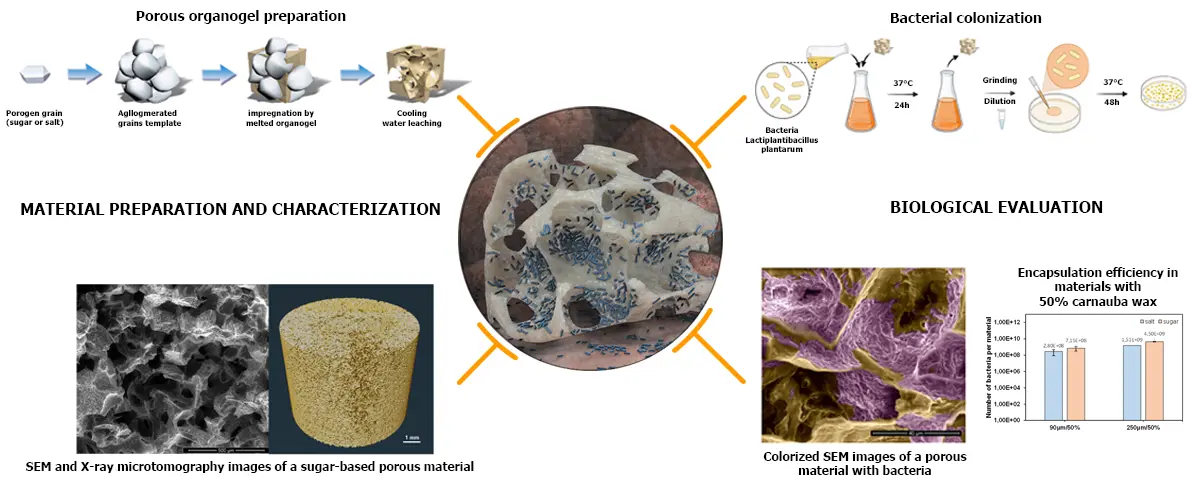
In this context, the first part of her research focuses on the development of microporous organogels as novel oral carriers for probiotics. These materials are semi-solid, porous three-dimensional matrices in which an organic liquid is immobilized within a network formed through the self-assembly of an organogelator. They were prepared from carnauba wax, soybean oil, and a water-soluble porogen (either sugar or salt). Their structural characterization, performed using scanning electron microscopy, X-ray microcomputed tomography, and drainage measurements, revealed highly interconnected porous networks whose architecture depends on the nature and size of the porogen. This porous structure promotes nutrient diffusion, bacterial growth, and bacterial protection. Furthermore, mechanical characterization showed that the stiffness of the materials increased with wax content and was also modulated by the porous architecture, highlighting clear relationships between structure and mechanical properties. Finally, biological evaluation using Lactiplantibacillus plantarum as a model probiotic demonstrated efficient colonization throughout the porous network. Salt-based materials enabled the immobilization of approximately 1×10⁹ bacteria, whereas sugar-based materials immobilized approximately 5×10⁹ bacteria. Protection of the bacteria against gastrointestinal conditions, as well as their targeted release in the colon, was also demonstrated using an artificial digestive system. Salt-based materials exhibited superior performance in terms of bacterial survival, with 33% of the initially immobilized bacteria remaining viable (approximately 2×10⁸ bacteria), compared with only 7% (approximately 5×10⁷ bacteria) for sugar-based materials. These findings demonstrate the potential of microporous organogels as innovative carriers for the oral delivery of probiotics.
Although the administration of live probiotics offers significant therapeutic potential, it is more challenging to implement and may entail a risk of bacterial dissemination. An alternative strategy is the direct administration of their bioactive metabolites, known as pharmabiotics, which are responsible for part of their beneficial effects. However, the isolation and targeted delivery of these metabolites remain major challenges. Owing to their high drainage capacity, microporous organogels, which have already been used to capture and concentrate hydrophobic compounds, could also serve as selective capture and concentration platforms for lipophilic metabolites produced by probiotics.
In the second part of her thesis, this concept was evaluated for the first time using a lipophilic fluorescent model compound.
Highlights of the thesis:
- Andrea presented her research in 2 international conferences: RICI X in Portugal in June 2024 and 15th PBP World Meeting in Prague in Marche 2026;
- 2 articles on her work were also published in: International Journal of Cosmetic Science and Colloids and surfaces A: Physicochemical and Engineering Aspects.
Congratulations to Andrea for the quality of her work!