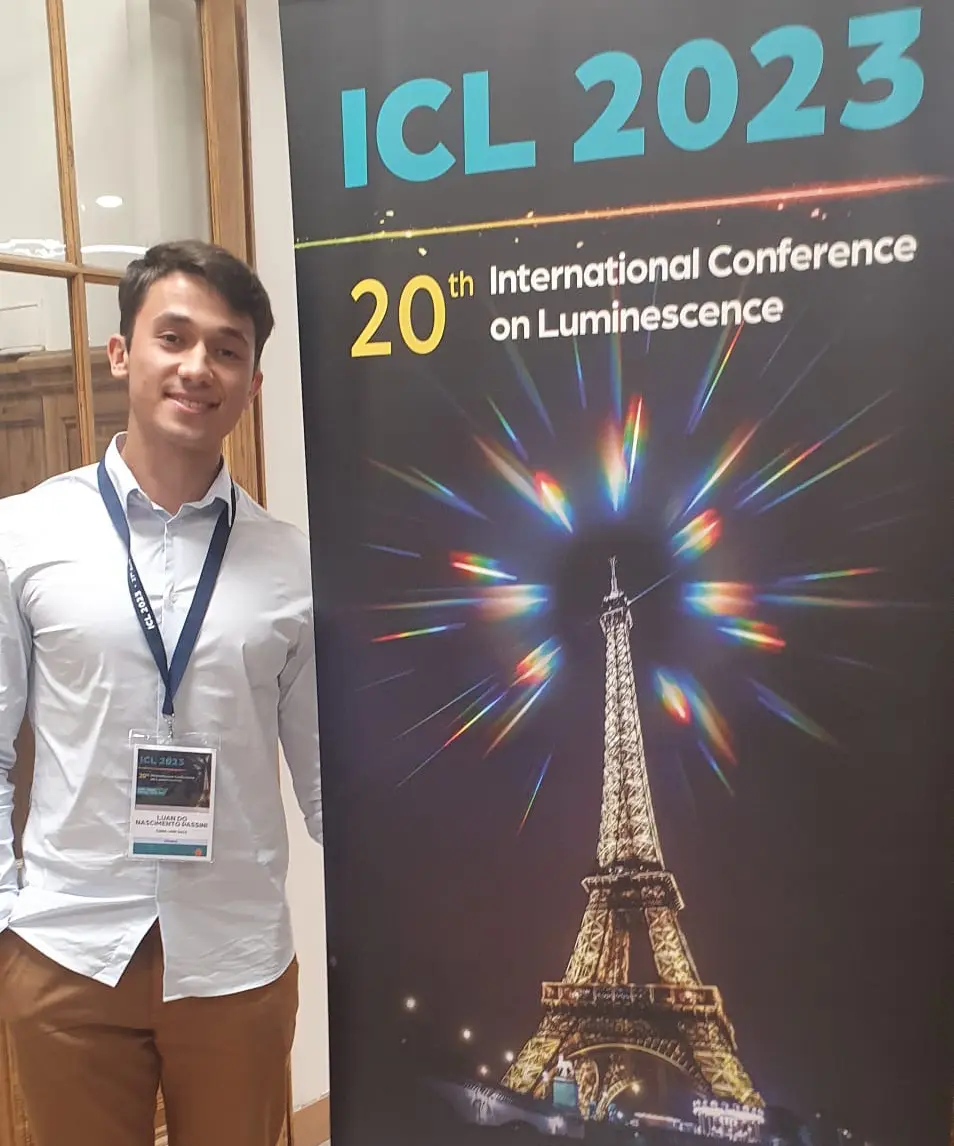
Luan carried out his research in the IDeAS team at the Softmat laboratory.
On 4th of July, he defended his thesis entitled: “Synthesis and characterisation of lanthanide-based nanoparticles for time-gated imaging in the near infrared”
His work focused on the development of upconverting nanoparticles (UCNPs) designed for use as contrast agents in asynchronous optical imaging within the near-infrared (NIR) region.
The synthesised nanoparticles, based on a β-NaYF4 host matrix, were co-doped with 3 lanthanide ions Tm3+, Yb3+ and Nd3+, in order to achieve Tm3+ emission at 802 nm upon excitation of Nd3+ at 808 nm. To minimise non-radiative processes such as cross-relaxation (CR), back energy transfer, and general luminescence quenching, a core@multishell architecture was implemented. The Nd-Yb-Tm triad was spatially separated across distinct layers: the core contained Tm3+ and Yb3+; an intermediate shell incorporated Yb3+ exclusively; and the outermost shell comprised Nd3+ and Yb3+. In this configuration, Tm3+ acts as the activator, Yb3+ serves as an energy mediator, and Nd3+ functions as the sensitizer that absorbs 808 nm excitation light.
The UCNPs were synthesised via a high-temperature co-precipitation method, with optimisation efforts directed toward achieving high crystallinity and phase purity. Structural and morphological characterisation was carried out using transmission electron microscopy (TEM), high-resolution TEM (HRTEM), X-ray powder diffraction (XRPD), and small-angle X-ray scattering (SAXS), confirming the formation of monodisperse β-NaYF4 nanoparticles ranging from 10 to 35 nm.
Photoluminescence measurements under 980 nm excitation demonstrated enhanced upconversion (UC) emission from core@multishell architectures compared to other configurations. Upon 808 nm excitation, efficient energy transfer through the Nd-Yb-Tm pathway was observed. Time-resolved spectroscopy revealed long luminescence lifetimes in the microsecond to millisecond range. To further enhance UC performance, dye-sensitization strategies were explored. Due to their larger absorption cross sections, organic dyes enabled Förster resonance energy transfer (FRET) to the UCNPs, leading to UC intensity enhancements of up to 40, 800-, 797-, and 604-fold relative to non-sensitized controls.
However, the frequently used dye ICG displayed poor photostability under prolonged laser exposure, indicating a need for more robust sensitizers. For biological applications, water-dispersible UCNPs were prepared and evaluated under 808 nm excitation in aqueous media, successfully producing UC emissions. Cytotoxicity was assessed via MTT assays in H9c2, HUVEC, and HCF cell lines after 24 and 48 hours of exposure. H9c2 cells were the most sensitive, followed by HUVECs; HCFs showed no significant cytotoxicity up to concentrations of 200 µg·mL⁻¹.
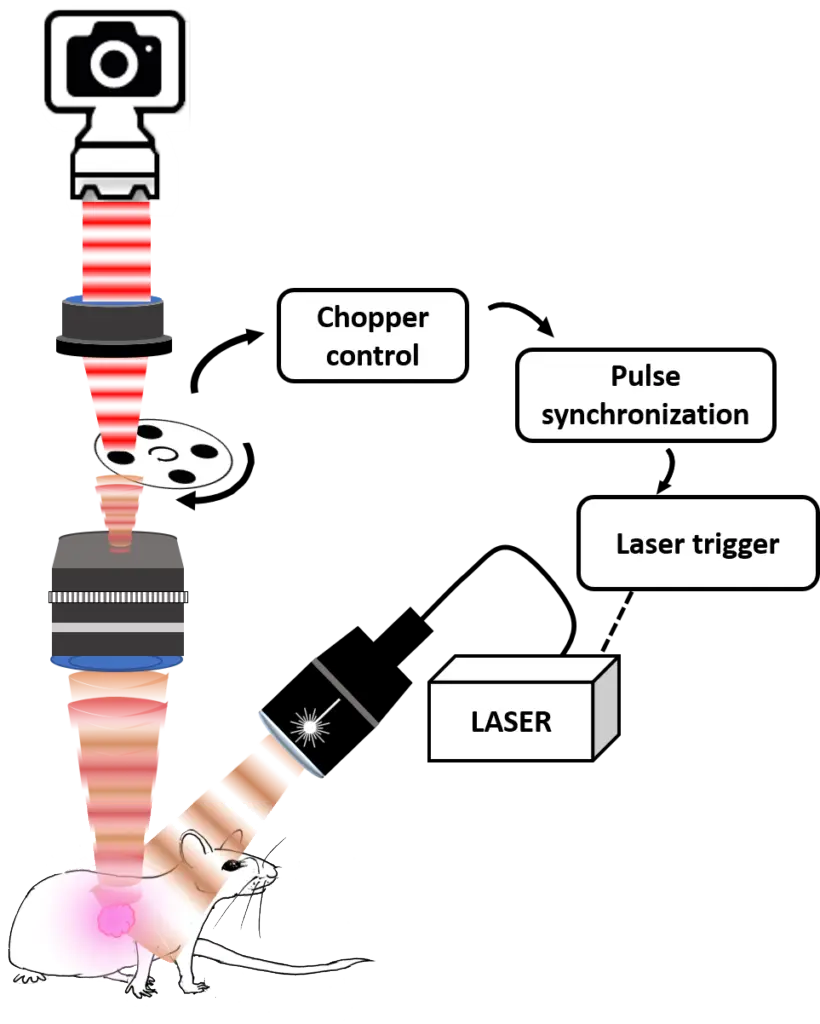
Finally, a custom-built time-gated imaging system was developed and tested. The system demonstrated efficient asynchronous imaging by excitation and detection at 800 nm, exploiting the high transparency of biological tissue in this spectral region. Results confirmed the feasibility and potential of this approach for in vivo optical imaging. Photoacoustic spectroscopy was also performed, revealing the promising potential of the UCNPs for in vivo imaging applications.
Highlights of the thesis:
- In the summer of 2023, Luan won a scholarship from the Nano-X University Research School to carry out photophysics experiments at the University of Aveiro in Portugal. Hosted by Professors Luis Carlos and Carlos Brites, specialists in the luminescence of lanthanide ions, Luan was able to determine the characteristic time profiles of the nanocrystals he had synthesised in Toulouse.
- Luan has also been selected to give an oral presentation at the 20th International Conference on Luminescence (ICL 2023), in Paris in August 2023. On this occasion, he demonstrated the potential of lanthanide-based nanocrystals as contrast agents in small animal imaging, in a mode of operation where excitation and signal collection are separated in time.
Congratulations to Luan for the quality of his work and his recruitment for a post-doctorate at the Lawrence Berkeley National Laboratory in the USA!