Yuezhan carried out his research in the IDeAS team at the Softmat laboratory.
On 18th of March, he defended his thesis entitled: “CO₂- and thermo-responsive block copolymers: synthesis, properties and assembly in water”
The core characteristics of stimulus-responsive materials are “responsiveness” and “reversibility.” They are typically composed of polymers, composites, or nanosystems with specific functional groups or variable conformational structures. Based on the type of stimulus, they can be divided into single-stimulus-responsive materials (such as temperature-responsive, pH-responsive, and light-responsive materials) and multi-stimulus-responsive materials (such as composite systems that are simultaneously sensitive to temperature and light).
Since the 1980s, stimulus-responsive materials have become a research hotspot in materials science and chemical engineering. Early research mainly focused on thermoresponsive and pH-responsive polymers, such as poly(N-isopropylacrylamide) (PNIPAM) hydrogels. In the 21st century, with the integration of nanotechnology and polymer chemistry, optical, electrical, magnetic, and multi-stimulus-responsive materials have emerged. Especially in the biomedical field, these materials are used in targeted drug delivery, intelligent release systems, and tissue engineering scaffolds, enabling precise drug release and biocompatibility regulation based on changes in the in vivo microenvironment (such as temperature or pH gradients).
A bibliographic overview of thermo-, pH- and CO2-sensitive (co)polymers is firstly presented in this thesis. The most commonly studied thermo-, pH- and CO2-responsive (co)polymers as well as the techniques used for their characterisation in solution are presented. Some examples illustrating how the polymer structure (architecture, block sequence) and polymer concentration can influence the aggregation properties of such polymer in solution upon application of different stimuli are presented too. A short overview of the synthetic strategies and typical applications of such multi-stimuli responsive (co)polymers are finally given.
It has been investigated the effect of copolymer composition on the formation, stabilisation properties of gold nanoparticles (AuNPs) stabilised by a thermoresponsive polymer. PNIPAM-b-PDEAEAM copolymers. Two synthetic methods are proposed to obtain such thermoresponsive hybrid NPs: (1) in situ formation and (2) coating of preformed AuNPs. The effect of copolymer composition, copolymer concentration, system pH and ionic strength on the colloidal properties of Au@polymer will be discussed.
Based on the bistimulus-responsive monomer DEAEAM, he first synthesised homopolymers PD of different molecular weights using the RAFT method. We found that the monomer conversion rate of the polymerisation reaction varied with different solvents. We discussed this issue in detail, particularly focusing on the solvent itself; the viscosity and relative polarity of the solvent seemed to have a significant impact on the monomer conversion rate. Furthermore, he synthesised several other block copolymers based on PD, and the introduction of different blocks led to significant changes in the polymer properties. This provides with a broader scope for utilizing PD as a bistimulus-responsive stimulus-responsive polymer.
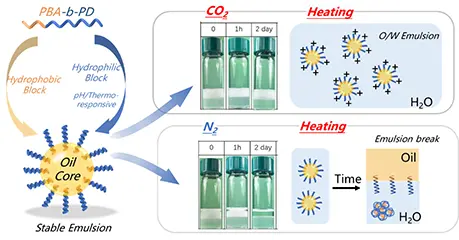
Based on the synthesised homopolymers and copolymers of PD, he first tested their properties. He tested the cloud point Tc of these polymers, including the variation of Tc with concentration and with pH. He explored the physicochemical processes and thermodynamic mechanisms behind these changes. Additionally, he tested the CO2 responsiveness of these polymers. Then, he investigated the interfacial properties of these polymers, studying their response to the reduction of air-water and oil-water interfacial tensions. This is crucial for the aim to use this polymer system for stabilising emulsions.
Highlight of the thesis:
Yuezhan has developed polymers capable of adsorbing and desorbing CO₂, which he then used to coat gold particles with CO₂-sensitive optical properties, as well as to formulate emulsions whose stability can be modulated by temperature and CO₂ concentration.
Congratulations to Yuezhan for the quality of his work!